In Fdrs State of the Union Address How Does the Arrangement Affect the Reading
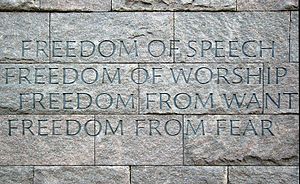
The 4 Freedoms were goals articulated by U.S. President Franklin D. Roosevelt on Mon, January half dozen, 1941. In an address known as the Four Freedoms speech (technically the 1941 State of the Union address), he proposed 4 key freedoms that people "everywhere in the world" ought to enjoy:
- Freedom of oral communication
- Freedom of worship
- Freedom from want
- Freedom from fearfulness
Roosevelt delivered his speech 11 months before the surprise Japanese assault on U.South. forces in Pearl Harbor, Hawaii and the Philippines that acquired the United States to declare state of war on Nihon, December 8, 1941. The Country of the Union speech earlier Congress was largely about the national security of the United States and the threat to other democracies from world war that was being waged across the continents in the eastern hemisphere. In the oral communication, he made a interruption with the long-held tradition of United States non-interventionism. He outlined the U.S. role in helping allies already engaged in warfare.
In that context, he summarized the values of democracy backside the bipartisan consensus on international involvement that existed at the time. A famous quote from the voice communication prefaces those values: "As men practice not live by bread alone, they practice not fight by armaments alone." In the second half of the voice communication, he lists the benefits of democracy, which include economic opportunity, employment, social security, and the hope of "acceptable health intendance". The starting time two freedoms, of speech and religion, are protected by the First Amendment in the U.s. Constitution. His inclusion of the latter two freedoms went beyond the traditional Ramble values protected by the U.S. Beak of Rights. Roosevelt endorsed a broader human right to economic security and anticipated what would become known decades later as the "human security" paradigm in social science and economic development. He as well included the "freedom from fear" against national aggression and took it to the new United Nations he was setting up.
Historical context [edit]
In the 1930s many Americans, arguing that the involvement in Earth War I had been a mistake, were adamantly against continued intervention in European affairs.[1] With the Neutrality Acts established after 1935, U.S. police banned the sale of armaments to countries that were at war and placed restrictions on travel with argumentative vessels.[2]
When World War II began in September 1939, the neutrality laws were even so in effect and ensured that no substantial support could be given to United kingdom and France. With the revision of the Neutrality Human action in 1939, Roosevelt adopted a "methods-short-of-war policy" whereby supplies and armaments could be given to European Allies, provided no declaration of war could be made and no troops committed.[three] By December 1940, Europe was largely at the mercy of Adolf Hitler and Germany'south Nazi regime. With Germany's defeat of French republic in June 1940, Britain and its overseas Empire stood solitary confronting the military machine brotherhood of Deutschland, Italy, and Nippon. Winston Churchill, equally Prime number Government minister of Britain, called for Roosevelt and the The states to supply them with armaments in order to proceed with the state of war effort.[ citation needed ]
The 1939 New York Earth'due south Off-white had celebrated Four Freedoms – religion, voice communication, press, and assembly – and commissioned Leo Friedlander to create sculptures representing them. Mayor of New York City Fiorello La Guardia described the resulting statues every bit the "heart of the off-white". Later Roosevelt would declare his own "Four Essential Freedoms" and telephone call on Walter Russell to create a Four Freedoms Monument that was eventually dedicated at Madison Square Garden in New York City.[4]
They too appeared on the opposite of the AM-lira, the Allied Military machine Currency note upshot that was issued in Italy during WWII, by the Americans, that was in effect occupation currency, guaranteed by the American dollar.
Declarations [edit]
The Four Freedoms Speech communication was given on Jan half dozen, 1941. Roosevelt's hope was to provide a rationale for why the The states should abandon the isolationist policies that emerged from Earth War I. In the address, Roosevelt critiqued Isolationism, proverb: "No realistic American tin expect from a dictator's peace international generosity, or return of true independence, or world disarmament, or liberty of expression, or freedom of faith–or even proficient concern. Such a peace would bring no security for us or for our neighbors. "Those, who would requite upwards essential liberty to purchase a fiddling temporary safety, deserve neither liberty nor safety."[5]
The speech coincided with the introduction of the Lend-Lease Human action, which promoted Roosevelt's plan to become the "arsenal of commonwealth"[half-dozen] and support the Allies (mainly the British) with much-needed supplies.[7] Furthermore, the speech established what would go the ideological basis for America's involvement in World War II, all framed in terms of private rights and liberties that are the hallmark of American politics.[1]
The speech delivered past President Roosevelt incorporated the following text, known as the "4 Freedoms":[5]
In the future days, which nosotros seek to brand secure, we look forrad to a world founded upon four essential human freedoms.
The start is freedom of speech and expression—everywhere in the earth.
The second is liberty of every person to worship God in his own way—everywhere in the world.
The third is liberty from want—which, translated into world terms, means economical understandings which volition secure to every nation a healthy peacetime life for its inhabitants—everywhere in the earth.
The fourth is freedom from fear—which, translated into world terms, means a world-wide reduction of armaments to such a point and in such a thorough fashion that no nation will exist in a position to commit an deed of physical assailment against whatever neighbour—anywhere in the world.
That is no vision of a distant millennium.
It is a definite basis for a kind of globe accessible in our ain time and generation.
That kind of world is the very antonym of the so-called new society of tyranny which the dictators seek to create with the crash of a bomb.
—Franklin D. Roosevelt, excerpted from the Country of the Wedlock Address to the Congress, January half-dozen, 1941

The declaration of the Four Freedoms as a justification for war would resonate through the residual of the war, and for decades longer as a frame of remembrance.[i] The Freedoms became the staple of America's war aims and the heart of all attempts to rally public support for the war. With the creation of the Office of War Information (1942), as well as the famous paintings by Norman Rockwell, the Freedoms were advertised every bit values primal to American life and examples of American exceptionalism.[viii]
Opposition [edit]
The Iv Freedoms Speech was popular, and the goals were influential in postwar politics. However, in 1941 the speech communication received heavy criticism from anti-war elements.[9] Critics argued that the Four Freedoms were simply a charter for Roosevelt'south New Deal, social reforms that had already created sharp divisions inside Congress. Conservatives who opposed social programs and increased government intervention argued confronting Roosevelt's endeavour to justify and depict the state of war every bit necessary for the defense of lofty goals.[ten]
While the Freedoms did become a forceful attribute of American thought on the war, they were never the exclusive justification for the war. Polls and surveys conducted past the The states Part of War Information (OWI) revealed that "cocky-defense", and vengeance for the assail on Pearl Harbor were still the nearly prevalent reasons for war.[eleven]
Limitations [edit]
In a 1942 radio address, President Roosevelt declared the Iv Freedoms embodied "rights of men of every creed and every race, wherever they alive."[12]
On February 19, 1942, President Roosevelt authorized Japanese American internment and internment of Italian Americans with Executive Order 9066, which allowed local armed forces commanders to designate "military machine areas" every bit "exclusion zones", from which "any or all persons may be excluded". This power was used to declare that all people of Japanese ancestry were excluded from the entire Pacific declension, including all of California and much of Oregon, Washington, and Arizona, except for those in internment camps.[13] By 1946, the United States had incarcerated 120,000 individuals of Japanese descent, of whom well-nigh 80,000 had been born in the United States.[14]
Un [edit]
The concept of the Four Freedoms became role of the personal mission undertaken by First Lady Eleanor Roosevelt regarding her inspiration behind the Un Declaration of Human Rights, General Assembly Resolution 217A. Indeed, these Four Freedoms were explicitly incorporated into the preamble to the Universal Annunciation of Man Rights which reads, "Whereas disregard and contempt for human rights have resulted in barbarous acts which take outraged the conscience of mankind, and the advent of a world in which man beings shall enjoy the liberty of speech and conventionalities and freedom from fear and want has been proclaimed the highest aspiration of the mutual people."[15]
Disarmament [edit]
FDR called for "a world-broad reduction of armaments" as a goal for "the future days, which we seek to make secure" just one that was "accessible in our ain time and generation." More immediately, though, he called for a massive build-up of U.S. arms production:
Every realist knows that the democratic manner of life is at this moment beingness directly assailed in every role of the world ... The need of the moment is that our actions and our policy should be devoted primarily—virtually exclusively—to meeting this foreign peril. ... [T]he firsthand need is a swift and driving increase in our armament product. ... I also enquire this Congress for dominance and for funds sufficient to manufacture additional munitions and war supplies of many kinds, to be turned over to those nations which are now in bodily state of war with assailant nations.
—Franklin D. Roosevelt[16]
Franklin D. Roosevelt Iv Freedoms Park [edit]
The Franklin D. Roosevelt Iv Freedoms Park is a park designed by the architect Louis Kahn for the south point of Roosevelt Island.[17] The park celebrates the famous speech, and text from the speech is inscribed on a granite wall in the final pattern of the park.
Awards [edit]
The Roosevelt Establish[eighteen] honors outstanding individuals who have demonstrated a lifelong commitment to these ideals. The Four Freedoms Award medals are awarded at ceremonies at Hyde Park, New York and Middelburg, Netherlands during alternate years. The awards were first presented in 1982 on the centenary of President Roosevelt'southward nativity every bit well every bit the bicentenary of diplomatic relations betwixt the Us and holland.
Among the laureates have been:
- William Brennan
- H.M. Juan Carlos of Kingdom of spain
- Jimmy Carter
- Bill Clinton
- The Dalai Lama
- Mikhail Gorbachev
- Averell Harriman
- Václav Havel
- H.R.H. Princess Juliana of kingdom of the netherlands
- John F. Kennedy
- Mike Mansfield
- Paul Newman
- Tip O'Neill
- Shimon Peres
- Coretta Scott Male monarch
- Brent Scowcroft
- Harry Southward. Truman
- Liv Ullmann
- Elie Wiesel
- Joanne Woodward
In popular culture [edit]
- John Crowley's novel 4 Freedoms (2009) is largely based on the themes of Roosevelt'due south speech.[ commendation needed ]
- FDR commissioned sculptor Walter Russell to design a monument to be dedicated to the offset hero of the war. The Four Freedoms Monument was created in 1941 and dedicated at Madison Square Garden, in New York City, in 1943.
- Creative person Kindred McLeary painted America the Mighty (1941), also known equally Defense of Human Freedoms, in the State Department's Harry Due south. Truman Building.[19]
- Artist Hugo Ballin painted The 4 Freedoms mural (1942) in the Quango Bedroom of the City Hall of Burbank, California.[20]
- New Jersey muralist Michael Lenson (1903–1972) painted The Four Freedoms mural (1943) for the Fourteenth Street School in Newark, New Jersey.[21]
- Muralist Anton Refregier painted the History of San Francisco murals (completed 1948) in the Rincon Center in San Francisco, California; console 27 depicts the four freedoms.[22]
- Artist Mildred Nungester Wolfe painted a iv-panel Four Freedoms mural (complete 1959) depicting the four freedoms for a country shop in Richton, Mississippi. Those panels now hang in the Mississippi Museum of Fine art.[23]
- Allyn Cox painted 4 Four Freedoms murals (completed 1982) which hang in the Peachy Experiment Hall in the United States House of Representatives; each of the 4 panels depicts emblematic figures representing the four freedoms.[24]
- Since 1986, the fictional Four Freedoms Plaza has served equally the headquarters for Marvel Comics superhero team Fantastic Four.[ citation needed ]
- In the early 1990s, artist David McDonald reproduced Rockwell'due south Four Freedoms paintings as four large murals on the side of an quondam grocery building in downtown Silverton, Oregon.[25]
- In 2008, Florida International University'south Wolfsonian museum hosted the Thoughts on Commonwealth exhibition that displayed posters created by sixty leading gimmicky artists and designers, invited to create a new graphic pattern inspired past American illustrator Norman Rockwell's Four Freedoms posters.[26]
Norman Rockwell'southward paintings [edit]
Roosevelt's speech inspired a prepare of four paintings past Norman Rockwell.
Paintings [edit]
The members of the fix, known collectively as The Four Freedoms, were published in 4 sequent issues of The Saturday Evening Postal service.[27] The iv paintings subsequently were displayed around the Us by the U.s.a. Department of the Treasury.
-

Liberty of Worship (Saturday, February 27, 1943) – from the Four Freedoms series by Norman Rockwell
-

Freedom from Want (Sabbatum, March 6, 1943) – from the Four Freedoms series past Norman Rockwell
-
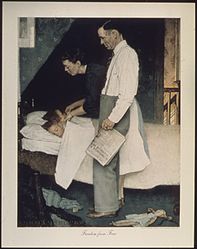
Freedom from Fear (Saturday, March thirteen, 1943) – from the Four Freedoms series by Norman Rockwell
Essays [edit]
Each painting was published with a matching essay on that particular "Freedom":[28]
- Freedom of Speech, by Booth Tarkington (Feb 20, 1943).[29]
- Freedom of Worship, by Will Durant (Feb 27, 1943).[xxx]
- Freedom from Want, past Carlos Bulosan (March 6, 1943).[31]
- Freedom from Fright, by Stephen Vincent Benét (March 13, 1943; the date of Benét'southward death).[32]
Stamp stamps [edit]
Rockwell's Iv Freedoms paintings were reproduced every bit postage stamp stamps by the Usa Mail service Role in 1943,[33] in 1946,[34] and in 1994,[35] the centenary of Rockwell'southward birth.
Come across also [edit]
- Four boxes of liberty
- Four Freedoms (European Marriage)
- Freedom from Fright: The American People in Depression and War, 1929–1945, a Pulitzer-winning history of the era.
- Liberalism in the United States
- 2d Beak of Rights, proposed by FDR in his 1944 State of the Spousal relationship Address
- The Free Software Definition is often called "the 4 freedoms" within the free software community in reference to the spoken language and cardinal principles.
- World War II Victory Medal (United States), which includes the Four Freedoms on its contrary.
Notes [edit]
- ^ a b c Bodnar, John, The "Practiced War" in American Memory. (Maryland: Johns Hopkins University Printing, 2010) 11
- ^ Kennedy, David M., Liberty From Fearfulness: the American people in depression and war, 1929–1945 (Oxford: Oxford University Press, 1999) 393–94
- ^ Kennedy, David M., Freedom From Fear: the American people in depression and state of war, 1929–1945 (1999) 427–434
- ^ Inazu, John D. (2012). Liberty'south Refuge: The Forgotten Freedom of Associates. Yale University Press. ISBN978-0300173154.
- ^ a b "FDR, "The Four Freedoms," Speech Text |". Voicesofdemocracy.umd.edu. January half dozen, 1941. Retrieved Baronial 14, 2014.
- ^ The Public Papers and Addresses of Franklin D. Roosevelt (New York: Random House and Harper and Brothers, 1940) 633–44
- ^ , Kennedy, David M., Freedom From Fright: the American people in depression and war, 1929–1945 (Oxford: Oxford Academy Printing, 1999) 469
- ^ Bodnar, John, The "Proficient War" in American Retentiveness. (Maryland: Johns Hopkins University Press, 2010) 12
- ^ Kennedy, David K., Liberty From Fear: the American people in depression and war, 1929–1945 (Oxford: Oxford University Printing, 1999) 470–76
- ^ Bodnar, John, The "Good War" in American Memory. (Maryland: Johns Hopkins University Press, 2010) 14–fifteen
- ^ Bodnar, John, The "Proficient War" in American Memory. (Maryland: Johns Hopkins University Press, 2010) 14
- ^ Foner, Eric, The Story of American Freedom. (New York: W.Due west. Norton, 1998) 223
- ^ Korematsu v. the United States dissent by Justice Owen Josephus Roberts, reproduced at findlaw.com. Retrieved September 12, 2006.
- ^ Park, Yoosun, Facilitating Injustice: Tracing the Function of Social Workers in the World State of war II Internment of Japanese Americans. (Social Service Review 82.3, 2008) 448
- ^ White, E.B.; Lerner, Max; Cowley, Malcolm; Niebuhr, Reinhold (1942). The United Nations Fight for the Four Freedoms. Washington, D.C.: Authorities Press Office. ASIN B003HKRK80.
- ^ Roosevelt, Franklin Delano (1941). – via Wikisource.
- ^ "About the Park". Four Freedoms Park Salvation. Archived from the original on July 27, 2014. Retrieved July 23, 2014.
- ^ Franklin and Eleanor Roosevelt Institute, Franklin and Eleanor Roosevelt Institute
- ^ Vo, Tuan (October 2010), "Forgotten Treasure", State Magazine, pp. 20–23, archived from the original on March 4, 2016, retrieved June 1, 2014
- ^ City Council Chamber & Murals , retrieved June 1, 2014
- ^ Official Website of Michael Lenson – WPA Muralist and Realist Painter , retrieved June ane, 2014
- ^ State of war and Peace (1948), SF Landscape Arts, retrieved June i, 2014
- ^ Lucas, Sherry (May 21, 2014). "Richton landscape donated to Miss. Museum of Art". Hattiesburg American . Retrieved June 1, 2014.
- ^ The American Story in Fine art: The Murals of Allyn Cox in the U.S. Capitol, The The states Capitol Historical Guild, retrieved June 1, 2014
- ^ Silverton Mural Society
- ^ "Thoughts on Democracy". Wolfsonian FIU. 2008. Archived from the original on March v, 2016. Retrieved May 29, 2015.
- ^ On Feb 20, 1943; February 27, 1943; March 6, 1943; and March xiii, 1943.
- ^ Perry, P., (2009a) "Norman Rockwell'southward Four Freedoms", The Saturday Evening Mail service, January/February 2009; Perry, P., (2009b) "Norman Rockwell's Four Freedoms", The Sabbatum Evening Post, January/Feb 2009;
- ^ "Booth Tarkington'southward 'Liberty of Speech', The Saturday Evening Mail, January/February 2009". Dec 21, 2017.
- ^ "Will Durant's 'Freedom of Worship', The Saturday Evening Mail, Jan/February 2009". December 21, 2017.
- ^ "Carlos Bulosan's 'Freedom from Want', The Saturday Evening Post, January/February 2009". December 21, 2017.
- ^ "Stephen Vincent Benét's 'Freedom from Fear', The Saturday Evening Post, January/February 2009". December 21, 2017.
- ^ Scott Catalog souvenir canvass of four stamps
- ^ Scott Catalog souvenir canvas of four stamps
- ^ Scott Catalog souvenir canvass of four stamps, archived from the original on July 23, 2011, retrieved Nov 23, 2010
External links [edit]
- "4 Freedoms" Lesson program for grades 9–12 from National Endowment for the Humanities
- As a delivered text, enhanced audio, video excerpt at AmericanRhetoric.com.
- Text and audio.
- "FDR4Freedoms Digital Resource" The digital instruction resource of the Franklin D. Roosevelt Four Freedoms Park
- "Franklin D. Roosevelt Four Freedoms Park"
- 1941 Four Freedoms Spoken language (via YouTube)
Source: https://en.wikipedia.org/wiki/Four_Freedoms
0 Response to "In Fdrs State of the Union Address How Does the Arrangement Affect the Reading"
Post a Comment