Wgen Will the Lhc Be Ready Again
Since shutting down in early 2013, the most powerful particle accelerator on the planet, the Big Hadron Collider (LHC), has been sitting dormant. Over the past two years this scientific colossus situated at CERN near Geneva, Switzerland, has undergone a series of repairs and upgrades. Just now it is gear up to reawaken from it's slumber.
This new era will meet a collider with near double the previous energy, with collisions at 13 TeV. Scaled up into our macroscopic world, the force of these collisions between protons is roughly equivalent to an apple hit the moon difficult plenty to create a crater more 9.5km (6 miles) across.
This new energy borderland will permit researchers to probe beyond the current boundaries of our agreement of the fundamental structure of thing in search of new discoveries.
Detector upgrades
In guild to brand the near of the new accelerator conditions, the discovery experiments, ATLAS and CMS, have undergone further upgrades during the shutdown menses.
Most notably the ATLAS experiment has added an entirely new detector, the Insertable b-Layer, or IBL. This sits very close to the point where the protons slam into each other, creating a cascade of other subatomic particles.
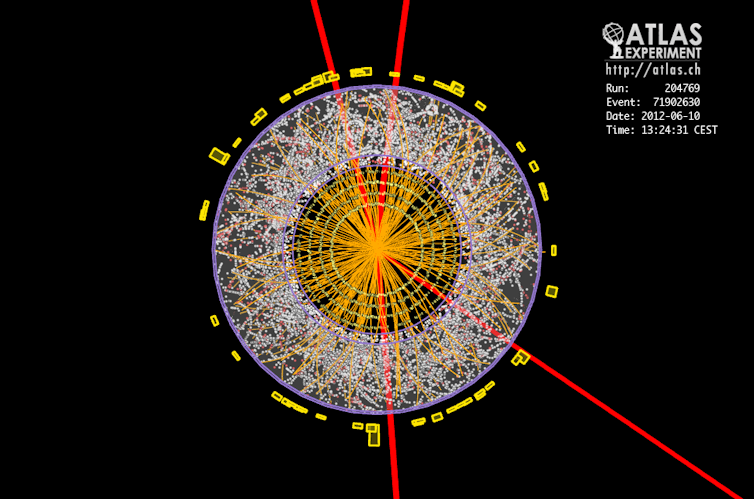
Because the IBL sits closer to the action than the original detectors – which are also still in use – information technology provides an additional measurement bespeak for particles originating from the collisions, assuasive greater accuracy on the resulting measurements.
The IBL will be specially important for identifying heavy particles, such as bottom quarks, which are produced during decays of short-lived particles such as the Higgs boson and are crucial for measurements of the top quark (which decays to a bottom quark and West boson).
Across the Higgs boson
During the first run of the LHC in 2012, the ATLAS and CMS experiments ended the 50 year hunt for the Higgs boson, which was predicted by the Standard Model –- a theory governing all particles, forces and interactions.
Having measured the mass of the Higgs boson by looking at the way it decays into other particles, LHC scientists and so went one stride farther. In 2013 they measured the properties of the boson, all of which proved consistent with the predictions of the Standard Model.
At present physicists want to know if the Higgs they found is hiding any surprises. And, perhaps more chiefly, what may be lurking across information technology. The increment in LHC energy is coupled with an increase in luminosity, which allows physicists to probe rare events with greater frequency.
This high luminosity in concert with the increase in energy provides an unprecedented environment to interrogate fundamental physics across the limits of our current cognition. The kickoff thing to do with the new data is to study the Higgs boson in depth to see if anything disagrees with prediction.
This could exist a window into new physics. Considering the Higgs boson loves mass, scientists suspect that it might interact with a range of hidden, massive particles that we cannot see, such as potential candidates for nighttime affair.
If the Higgs boson is partying with as even so undiscovered particles, physicists hope that their newly improved particle collider and upgraded detector instruments will let them to crash the party -– and find out something about the attendees!

Supersymmetry, night affair and other exotica
Even if the Higgs boson were to go on to hold with the Standard Model predictions, the value of its mass is still suggestive of other interesting goings-on in the universe.
When LHC physicists measured the Higgs mass, they found it was lower than what they anticipated. This might brand sense if information technology was being caused – or protected – by one or more particles that be at a higher mass and were governed by some new "symmetry".
Supersymmetry is one such extension of the Standard Model that would yield additional partners of the known objects that may appear in high-energy LHC collisions.
These particles could act as "bodyguards" of the Higgs, influencing its measured mass. These supersymmetric particles could potentially be produced in the adjacent run of the LHC, perhaps even as early as this year.
Ane natural issue of certain supersymmetric models is the production of invisible stable massive particles that are weakly interacting. Such a particle would exist an excellent candidate for dark matter, the mysterious invisible matter that we accept thus far only detected via its gravitational effect.
Providing clues as to the nature of nighttime matter is one of the main motivators of the increased energy and intensity of the LHC collisions. Any prove of night matter and/or results consistent with supersymmetry would be hugely significant and would open up up a new chapter in our understanding of the universe at a fundamental level.
But the experiments must be prepared for any possible signature to be manifested in their collisions, and later on mine the data for evidence of exotic resonant structures, extra dimensions or long-lived particles among many other possibilities.
Then 2022 promises to exist a once in a lifetime opportunity for a generation of physicists who volition turn on and commission a automobile at unprecedented energies. With new discoveries potentially merely around the corner this may well be a defining time in the field of high free energy particle physics.
Source: https://theconversation.com/the-lhc-is-back-and-its-ready-to-probe-the-limits-of-matter-37638
0 Response to "Wgen Will the Lhc Be Ready Again"
Post a Comment